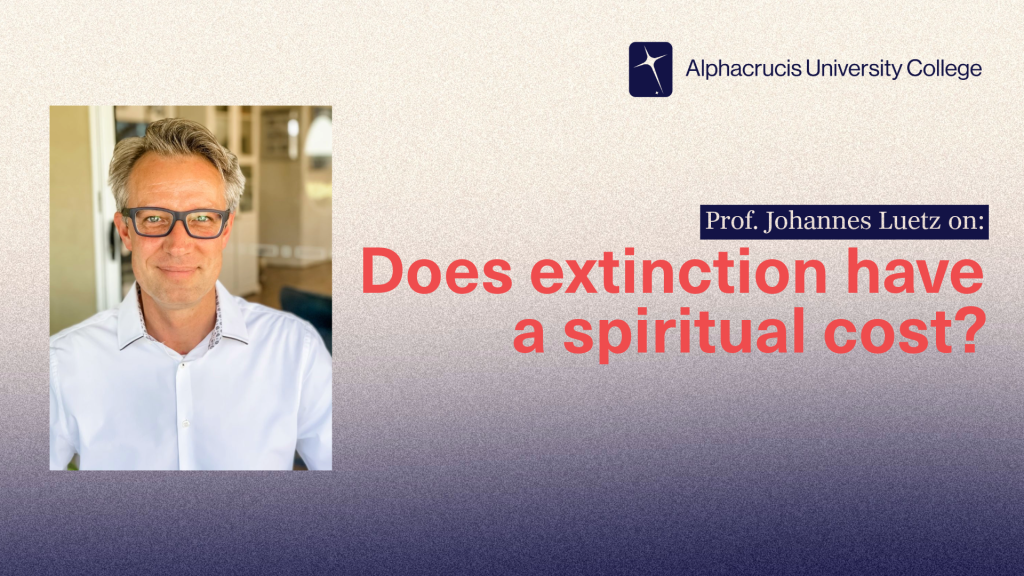
Does the extinction of animal species affect our spirituality? Johannes Luetz, AC’s Professor of Sustainability and Religion, argues that it does. In his recent article in The Conversation (based on research he published in the journal Ambio), he writes that every extinction comes with a “hidden toll” on humanity.
Extinction, he argues, should be understood not only as a biological or ecological crisis, but also as a crisis of human knowledge. When a species disappears, the loss extends beyond ecosystems: scientific insight, cultural memory, and spiritual meaning can disappear with it. The article places this argument within the context of the current biodiversity crisis, often described as a sixth mass extinction driven largely by human activity, and suggests that conservation is also a way of preserving forms of knowledge that enrich human life.
Professor Luetz develops this claim by showing that each species embodies unique knowledge that cannot simply be recovered once lost. On the scientific side, extinct species may take with them genetic, ecological, and biomedical possibilities that were never fully understood. The article uses the example of Queensland’s gastric-brooding frogs, whose remarkable reproductive biology may have held important medical insights. On the cultural side, species are woven into stories, ceremonies, and everyday cultural practices, so their disappearance can erode communal memory and inherited ways of seeing the world.
The article’s broader point is that conservation is not only about protecting nature for its own sake, but also about safeguarding a vast and irreplaceable archive of human and more-than-human knowledge.
Read his article at The Conversation, or see some of his published research in this area here: