Key Takeaways
- You can become a qualified teacher in two years if you already hold a degree in any discipline, through a Master of Teaching (primary or secondary).
- Australian teachers earn an average of $100,000–$105,000 per year, with NSW graduates starting at $90,177 and the top of the classroom scale reaching $129,536 (Seek, 2026; NSW Standards Agreement).
- Independent school enrolments grew 15.3% between 2021 and 2025 (ABS, 2025), and Independent Schools Australia projects 260 new schools or campuses will be needed over the next decade — meaning strong demand for qualified teachers, particularly in Christian schools.
- Commonwealth Supported Places reduce student contributions for eligible education courses from approximately $2,579 to $592 per subject — a 75% reduction.
- If you're over 21 without formal qualifications, Alphacrucis University College offers provisional entry — no Year 12 or prior study required.Alphacrucis education degrees are NESA accredited (NSW), ACECQA accredited (early childhood), and AITSL recognised — qualifying graduates to teach in government, Catholic, and Independent schools in any Australian state.
- All Alphacrucis teaching degrees are NESA accredited and AITSL recognised, qualifying graduates to teach in government, Catholic, and Independent schools in any Australian state.
To become a teacher in Australia, you need an accredited teaching qualification, a cleared Working With Children Check, and the ability to pass the LANTITE literacy and numeracy test before you graduate. The qualification takes two years if you’ve already got a degree (Master of Teaching) or four years if you’re starting from scratch (Bachelor of Education).
That’s the short version. The longer version depends on what kind of teacher you want to be — primary, secondary, or early childhood — and what stage of life you’re at when you decide teaching is what you want to do.
Right now, this is a profession with serious demand behind it. In 2024, 83% of Australian schools reported staffing shortages. Applications for teaching degrees are climbing — up 6.5% for 2026 — but the gap between the number of qualified teachers and the number of classrooms that need them isn’t closing quickly. STEM subjects, special education, and regional schools are particularly stretched.
And then there’s the Independent school sector: 3.4% enrolment growth in 2025 alone, 15.3% growth over the past four years, and projections that 260 new schools or campuses will be needed over the next decade (ABS, 2025; ISA, 2025). A significant share of that growth is in Christian schools — schools that don’t just need qualified teachers, but teachers who can integrate faith with their teaching practice.
This guide walks through the pathway from choosing your specialisation to landing your first teaching role, with a particular focus on what studying education at a Christian university college looks like in practice.
What does it take to become a teacher in Australia?
The pathway is more structured than most people expect. There are four clear steps, and they apply whether you’re a school leaver or a career changer in your forties.
| Step | What you need to do |
|---|---|
| 1 | Choose your specialisation — primary, secondary, or early childhood |
| 2 | Complete an accredited teaching qualification (4 years for a bachelor’s, 2 years for a master’s if you already have a degree) |
| 3 | Pass the LANTITE (Literacy and Numeracy Test for Initial Teacher Education) before graduating |
| 4 | Apply for teacher registration with your state authority (NESA in NSW, VIT in Victoria, QCT in Queensland, TRB in other states) |
Professional placements are built into every accredited teaching degree — a minimum of 80 days in schools for a bachelor’s program. These aren’t crammed into your final year. At some providers (including Alphacrucis University College), classroom experience starts in first year through embedded models like Teaching School Hubs.
How does teacher accreditation work?
Every Initial Teacher Education (ITE) program in Australia must be accredited by AITSL (the Australian Institute for Teaching and School Leadership) and the relevant state body. In NSW, that’s NESA. Once you complete an accredited degree, you can apply to register as a teacher in any Australian state or territory — you’re not locked into the state where you studied.
Registration starts at the Graduate level, and you’ll move to Proficient after a period of supervised teaching (usually your first two years in the classroom). Beyond Proficient, there are Highly Accomplished and Lead Teacher classifications, each with higher pay scales.
So what’s the difference between primary, secondary, and early childhood? It’s more than just the age of your students.
Primary vs secondary vs early childhood: which pathway fits?
| Primary | Secondary | Early Childhood | |
|---|---|---|---|
| Student age | 5–12 (Kindergarten to Year 6) | 12–18 (Year 7 to Year 12) | Birth to 5 (prior to school) or Birth to 8 |
| What you teach | All subjects across the curriculum | One or two specialist subject areas | Play-based learning, developmental milestones, family engagement |
| Qualification | Bachelor of Education (Primary) — 4 years, or Master of Teaching (Primary) — 2 years | Bachelor of Education (Secondary) — 4 years, or Master of Teaching (Secondary) — 2 years | Bachelor of Early Childhood Education — 3 years, or Bachelor of Education (Early Childhood and Primary) — 4 years |
| Accreditation body | NESA + AITSL | NESA + AITSL | ACECQA (+ NESA if the degree also covers primary) |
| Key difference | Generalist — you need breadth across literacy, numeracy, science, HSIE, creative arts | Specialist — you need depth in at least one teaching area (e.g. English, Maths, HSIE) | Focused on children’s development, wellbeing, and the early years learning framework |
If you want to teach in secondary schools, you’ll need a degree in a relevant discipline area (or teaching subjects within your education degree) to qualify in your specialisation. The most common secondary specialisations are English, Mathematics, Science, Humanities and Social Sciences (HSIE), and Religious Studies.
Not sure which pathway fits? The simple test: do you want to shape a child’s foundation across every subject, or do you want to go deep in the subject you’re passionate about? Primary teachers do the first. Secondary teachers do the second. Early childhood educators work with the youngest learners before they even reach a classroom.
Why study education at Alphacrucis?
Most education degrees in Australia will get you registered and into a classroom. The difference is what happens between enrolment and graduation — how you learn to teach, who you learn alongside, and what kind of teacher you become.
At Alphacrucis University College, three things are structurally different from what you’ll find at most other providers.
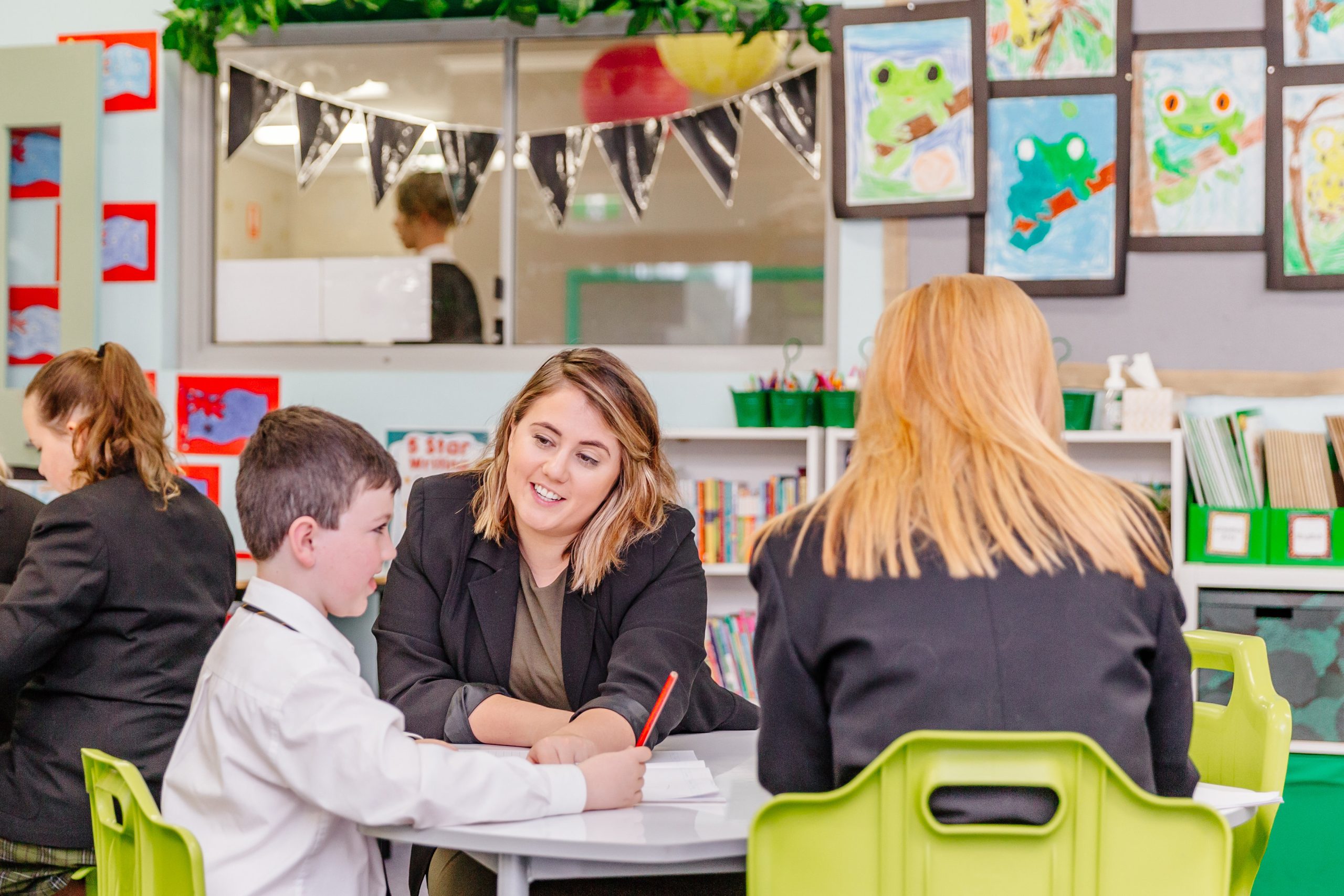
You’re in schools from first year, not just final year. Alphacrucis’s Teaching School Hubs place students in partner school communities from the start of their degree. You learn to teach while embedded in a school, mentored by experienced teachers, observing and practising before you’ve even finished your foundational subjects. Joshua Hales, a Bachelor of Education student in a Teaching School Alliance Hub in NSW, puts it this way:
“It is refreshing and encouraging to be able to learn to teach and have hands-on experience under a mentor teacher in my first year of study.” — Joshua Hales, Bachelor of Education, Teaching School Alliance Hub, NSW
That embedded model is backed by partnerships with 100+ Independent schools across Australia — schools that actively recruit Alphacrucis graduates because they’ve already seen them teach.
Your faith isn’t separate from your teaching practice. This isn’t a module called “Christianity and Education” bolted onto an otherwise secular degree. At Alphacrucis, Christian formation runs through the way you think about students, curriculum, and vocation. Naomi Cantwell, studying online from Victoria, describes it as “paradigm shifting — I’m really enjoying learning how my faith fits in with my future career and my life.”
Carolin Smolek, a graduate now teaching in Sydney, saw it show up in a moment her students noticed before she did:
“I recently had a Year 9 student ask me why I was different to other teachers. When I asked her what she meant by ‘different’, she said ‘Miss, you always give us a second chance.'” — Carolin Smolek, Bachelor of Theology & Master of Teaching, Sydney
That’s the Christian worldview at work — not announced, but visible in how a teacher treats students.
The qualifications are nationally recognised. All Alphacrucis teaching degrees are NESA accredited, AITSL recognised, and (for early childhood) ACECQA accredited. Graduates can register and teach in government, Catholic, and Independent schools in every Australian state and territory. And eligible domestic students can access Commonwealth Supported Places, which reduce fees from approximately $2,579 per subject to around $592 — a 75% saving.
What can you do with a teaching degree?
Teaching is one of those professions where the obvious career path (classroom teacher) is only the beginning. The qualification opens doors well beyond a single classroom.
Classroom teaching remains the core pathway. Australian teachers earn between $100,000 and $105,000 on average, with graduates starting between $79,000 and $96,000 depending on which state they’re in (Seek, 2026). In NSW, the graduate starting salary is $90,177, rising to $129,536 at the top of the classroom teacher scale. Highly Accomplished and Lead Teachers in NSW earn up to $141,997.
| Career pathway | What it involves | Typical salary range |
|---|---|---|
| Primary teacher | Teaching all subjects across K–6 | $90,000–$130,000 |
| Secondary teacher | Specialist subject teaching in Years 7–12 | $90,000–$130,000 |
| Early childhood educator | Leading learning for children birth to 5 | $65,000–$105,000 |
| Early childhood centre director | Managing an early learning centre | $80,000–$120,000 |
| Head of department | Leading a subject faculty in a secondary school | $120,000–$160,000 |
| Assistant principal / Deputy | School leadership and operational management | $140,000–$165,000 |
| Principal | Leading a school | $150,000–$215,000+ |
| Curriculum development | Designing learning programs at system or sector level | $100,000–$140,000 |
| Education policy | Working in government or sector bodies on education strategy | $100,000–$150,000 |
Salary ranges based on state education award scales and Seek data (2026). Figures vary by state, sector, and experience level.
But what about beyond the classroom? A teaching degree builds skills that transfer across sectors: program design, communication, assessment, team leadership, stakeholder management. Graduates work in corporate training, educational publishing, curriculum consulting, and NFP program management.
For Alphacrucis graduates specifically, there’s a pathway that’s harder to find elsewhere: teaching in Christian schools where your faith and your pedagogy are one integrated practice, not two separate things. With 100+ Independent school partnerships and the fastest-growing school sector in Australia actively recruiting, that’s a genuine employment advantage.
Is it worth noting the shortage data here? Yes. Teaching applications are climbing (up 6.5% for 2026 entry), but 83% of schools still reported staffing shortages in 2024. The demand is structural, not cyclical. STEM and special education are the hardest areas to fill, and regional schools across NSW, Queensland, and Victoria are offering relocation packages and incentives to attract qualified teachers.
Which education course is right for you?
Alphacrucis offers teaching qualifications at both undergraduate and postgraduate levels. The right course depends on where you’re at — school leaver, career changer, or experienced educator looking to formalise your skills.
| Course | Duration | Delivery | Who it’s for |
|---|---|---|---|
| Bachelor of Education (Primary) | 4 years FT (up to 12 years PT) | Online, Teaching School Hubs | School leavers and mature-age students wanting to teach primary (K–6) |
| Bachelor of Education (Secondary) | 4 years FT (up to 12 years PT) | Online, Sydney, Teaching School Hubs | Those wanting to specialise in English, Maths, HSIE, or Religious Studies |
| Bachelor of Education (Early Childhood and Primary) | 4 years FT (up to 12 years PT) | Online, Sydney, Teaching School Hubs | Those wanting dual accreditation across early childhood and primary |
| Bachelor of Early Childhood Education (Birth to 5) | 3 years FT (up to 8 years PT) | Online, Sydney | Those focused specifically on early learning (ACECQA accredited) |
| Bachelor of Arts and Bachelor of Education (Secondary) | 5 years FT (up to 12 years PT) | Online, Sydney, Teaching School Hubs | Those wanting a broad arts degree alongside a secondary teaching qualification |
| Master of Teaching (Primary) | 2 years FT (up to 5 years PT) | Online, Teaching School Hubs | Career changers with an existing degree who want to teach primary |
| Master of Teaching (Secondary) | 2 years FT (up to 5 years PT) | Online, Sydney, Teaching School Hubs | Career changers with an existing degree who want to teach secondary |
Secondary teaching specialisations currently available at Alphacrucis: English, Humanities and Social Sciences (HSIE), Mathematics, and Religious Studies. [VERIFY: whether additional specialisations have been added — check current course handbooks]
How do you choose?
If you’re a school leaver or you don’t have a prior degree, you’re looking at one of the four-year bachelor’s programs. The choice comes down to age group and breadth: primary if you want to teach across all subjects in one class, secondary if you want to teach your specialist subject across multiple year groups, early childhood and primary if you want the broadest scope from birth to Year 6, or early childhood (Birth to 5) if you’re focused on the years before school.
If you’ve already got a degree — in anything — the Master of Teaching is your fastest route. Two years of full-time study, and you’ll graduate with an accredited teaching qualification. Career changers make up a significant proportion of Master of Teaching cohorts; AITSL data shows they now represent 52% of some ITE student groups nationally.
And if you’re over 21 without formal qualifications? Alphacrucis has a provisional entry pathway that doesn’t require Year 12 completion or prior study. Your life experience and professional background are considered as part of the application.
What about fees and CSPs?
Commonwealth Supported Places are available for eligible domestic students in all Alphacrucis education courses. A CSP reduces your student contribution from approximately $2,579 per subject to around $592 — and you can defer that amount through FEE-HELP, meaning no upfront cost. If you’re over 21 and don’t secure a CSP, the Alphacrucis Education Scholarship reduces fees to approximately $2,425 per subject.
[LINK: CSP eligibility and scholarship information — https://www.ac.edu.au/future-students/bachelor-of-education-csps-and-scholarship-information/]
What’s it like studying education at Alphacrucis?
The best way to answer this is with the people who’ve done it. Five students, five different circumstances — from a school leaver who chose ministry-focused teaching over a high ATAR pathway, to an online student in Victoria who discovered her faith reshaped how she sees the classroom.
Joshua Hales started in a Teaching School Alliance Hub in NSW and was mentored by experienced teachers from his very first year. “I was so fortunate to have great teachers around me in my schooling,” he says, “and I want to be able to help other students grow academically and personally, as a way to thank my own teachers and to honour them, but also to work in a way that serves others, and contributes to God’s bigger picture.”
Naomi Cantwell studies entirely online from Victoria. For her, the shift was about integration: “Studying with Alphacrucis has been paradigm shifting. I’m really enjoying learning how my faith fits in with my future career and my life. Having started at Alphacrucis I feel the call to equip and disciple. Seeing teaching through a biblical lens has really reignited my passion!”
Briar Marshall is in a CEN Hub in Tasmania — proof that Alphacrucis’s reach extends well beyond Sydney. “Being taught as a Christian educator means what I learn in the classroom actually flows into all areas of life,” she says. “I can feel God’s presence at Alphacrucis, and it is such an encouraging and supportive journey to be on.”
Su Pheng Lim completed her Master of Teaching at the Sydney campus and describes the experience as pushing her “to go beyond my limits of self-centred thinking and teaching to inspirational leadership and role modelling in the classroom.”
And Carolin Smolek, whose “second chance” story opened an earlier section, represents the graduate outcome Alphacrucis is working toward: a teacher whose students can feel the difference her formation has made, even if they can’t name why.
What threads through all five stories is a pattern that’s hard to fake: these are people whose teaching practice was shaped by who they became during the degree, not just what they learned.
Frequently Asked Questions
How long does it take to become a teacher in Australia?
Four years through a Bachelor of Education, or two years through a Master of Teaching if you already hold a degree in any discipline. Part-time options extend these timelines — Alphacrucis allows up to 12 years for bachelor’s programs and up to 5 years for the Master of Teaching. Professional placements (minimum 80 days in schools) are completed during the degree, not after it.
Can I become a teacher without Year 12 or an ATAR?
Yes. If you’re over 21, Alphacrucis offers a provisional entry pathway that doesn’t require Year 12 completion. Mature-age applicants are assessed on professional experience and personal readiness for study. You’ll also need a Working With Children Check and a Police Check before placement subjects.
What is a Commonwealth Supported Place (CSP) for education?
A CSP is a government-subsidised study place that significantly reduces your student contribution. At Alphacrucis, a CSP reduces per-subject fees from approximately $2,579 to around $592 — a 75% reduction. CSPs are available for eligible domestic students in all Alphacrucis education and teaching courses. FEE-HELP can be used to defer the reduced amount, so there’s no upfront cost.
Can I teach in any state with an Alphacrucis degree?
Yes. All Alphacrucis teaching degrees are NESA accredited and AITSL recognised, which means graduates can apply for teacher registration in every Australian state and territory. You’re qualified to teach in government, Catholic, and Independent schools anywhere in Australia.
What’s the difference between a Bachelor of Education and a Master of Teaching?
Both lead to the same outcome — a fully accredited teaching qualification and eligibility for teacher registration. The Bachelor of Education is a four-year undergraduate degree designed for school leavers and those without a prior degree. The Master of Teaching is a two-year postgraduate degree for people who already hold a bachelor’s in any discipline and want to enter teaching as a career change.
Do I need to be Christian to study at Alphacrucis?
No. Alphacrucis welcomes students from all backgrounds. The college has a Christian worldview that’s integrated into its teaching practice — which is valued by the Christian school sector and by students who want their faith to shape their professional life — but there’s no faith requirement for admission.
What secondary teaching specialisations are available?
Alphacrucis currently offers secondary specialisations in English, Humanities and Social Sciences (HSIE), Mathematics, and Religious Studies. [VERIFY: whether additional specialisations have been added]
What are Teaching School Hubs?
Teaching School Hubs are an embedded learning model unique to Alphacrucis. Students are placed in partner school communities from first year — learning to teach while working alongside experienced teachers in real classrooms. It’s a mentored, immersive model that gives students practical experience from day one, rather than waiting until final-year placements.
Your next step
Three things you can do right now.
Explore the course that fits your pathway. If you’re a school leaver or don’t have a degree, look at the Bachelor of Education — choose between primary, secondary, early childhood and primary, or the BA/BEd double degree. If you’ve already got a degree and you’re changing careers, the Master of Teaching gets you into the classroom in two years.
Check your CSP eligibility. Commonwealth Supported Places reduce your fees by approximately 75%. Visit the CSP and Scholarship information page to see if you’re eligible.
Talk to someone who can help you choose. Alphacrucis’s Future Students team can walk you through the difference between courses, explain Teaching School Hub locations, and help you map a study plan around your work and family. Call 1300 228 355 or submit an enquiry.